Best Way to Send Money Home From the UAE in 2026
By Asfandyar Khan, UAE Gratuity Check
A practical comparison of banks, exchange houses, and transfer apps for UAE expats sending money home, plus how much rate shopping can actually save you.
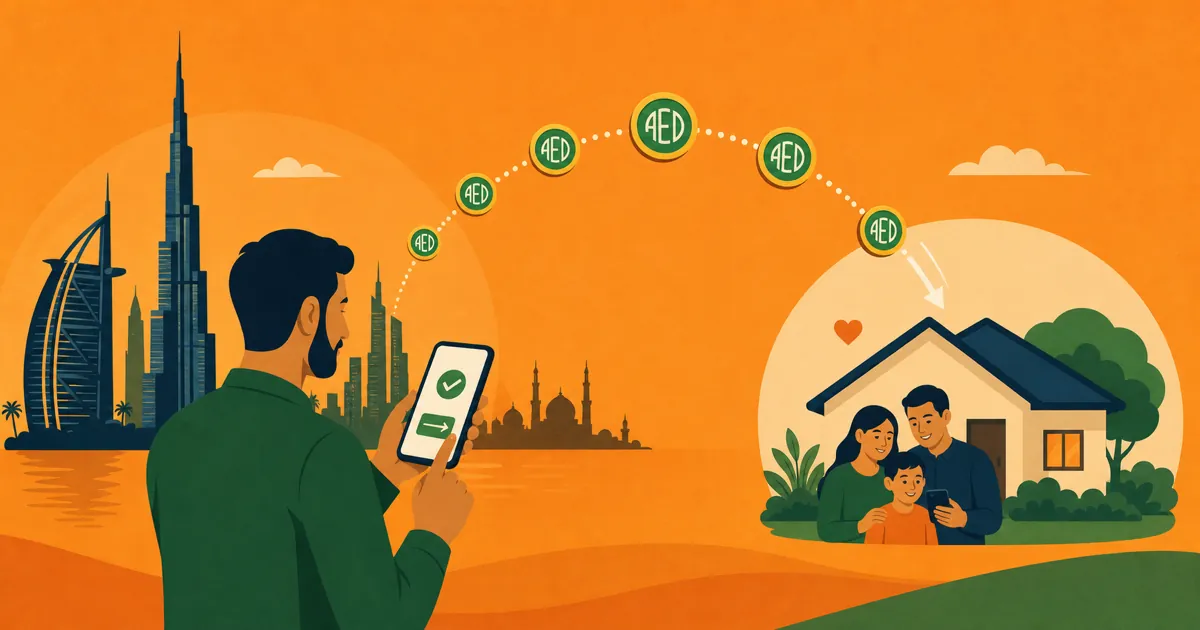
Millions of UAE residents send part of their salary home every month — to India, Pakistan, the Philippines, Bangladesh, Sri Lanka, Nepal, Egypt, and the UK, among many other places. The channel you pick to send it can quietly cost you hundreds of dirhams a year.
How the AED/USD peg affects your remittance
The UAE Central Bank has kept the dirham pegged to the US dollar at a fixed rate of 1 USD = 3.6725 AED since November 1997. That peg does not move — it is set by policy, not by daily trading — so your AED salary never gains or loses value purely against the dollar.
What does move is the dollar itself against your home currency. Because AED tracks USD one-for-one, whenever the dollar strengthens or weakens against the Indian rupee, Pakistani rupee, Philippine peso, or British pound, the AED rate against that currency moves with it. This is why the amount your family receives can change from month to month even though your UAE salary in dirhams stays exactly the same.
Understanding this helps you separate two different questions: "is my AED salary stable?" (yes, against the dollar, always) and "is my remittance worth the same every month?" (no, because your home currency is floating against the dollar, and therefore against AED too).
Comparing the three main ways to send money
UAE bank wire transfer: banks are convenient if you already hold an account and want funds to land directly in a recipient's bank account abroad. The tradeoff is usually the exchange rate — banks tend to build a wider margin into the rate they offer for international transfers, even when they advertise a low or zero transfer fee. The real cost is often hidden in the rate, not the fee line.
Exchange house counter or app: dedicated exchange houses (a long-standing option across the UAE) generally offer more competitive exchange rates than banks, and many now have apps so you do not need to visit a branch. Cash pickup is often available on the receiving end within minutes to hours, which matters for urgent transfers.
Fintech transfer apps: services in this category (for example apps like Wise or Remitly, among others) typically combine a rate close to the market mid-rate with a transparent, itemized fee shown before you confirm. Transfers are usually bank-to-bank rather than cash pickup, and delivery speed varies by corridor and payment method.
None of these three categories is universally "best" — the right choice depends on the amount you are sending, whether the recipient needs cash or a bank credit, how fast you need it there, and which corridor (destination country) you are sending to. The only reliable rule is to compare the total amount that arrives, not the advertised fee or rate in isolation.
How much you can realistically save by comparing rates
The gap between the best and worst available rate for the same corridor on the same day is usually small in percentage terms, but it adds up. On a monthly remittance of AED 5,000, the difference between a bank's rate and a competitive exchange house or app rate is commonly in the range of AED 50 to 200 per transfer, depending on the currency pair and how wide the provider's margin is that day.
Multiplied across twelve monthly transfers, that is roughly AED 600 to 2,400 a year — money that either reaches your family or quietly stays with whichever provider you used out of habit. For someone sending a larger amount, or sending less frequently in bigger transfers, the absolute rupee, peso, or taka difference can be even larger in a single transaction.
The habit that saves the most money is simple: check two or three providers' live rates for the same amount before you commit, rather than always using whichever app or bank branch is most convenient. It takes a few minutes and does not require switching providers permanently — just checking before each larger transfer.
Timing tips: why USD strength matters even for non-USD transfers
Because AED is pegged to the dollar, the dollar's broader strength or weakness against world currencies flows straight through to your remittance rate, even if you never touch USD directly. When the US dollar is broadly strong against a currency like the Indian rupee or Pakistani rupee, your AED (and therefore your remittance) buys more of that currency. When the dollar weakens against it, your remittance buys less.
This means remittance timing is really a question about USD strength against your specific home currency, not about the AED itself changing. You cannot control this movement, but you can avoid making it worse by not delaying a transfer purely out of habit once you have already decided to send — rates can move in either direction while you wait.
If your transfer amount and timing have some flexibility, keeping half an eye on your home currency's rate against the US dollar over a few weeks can help you notice unusually favorable weeks, without needing to actively trade currencies or time the market precisely.
A practical checklist before you send
Compare the live rate across at least two providers for the exact amount you plan to send — rates can differ by transfer size, not just by provider.
Check for hidden fees beyond the headline transfer fee, including receiving-end charges some banks apply to incoming international transfers.
Double-check recipient details — account number, IBAN, or mobile wallet ID, and the recipient's full name exactly as it appears on their bank records — since corrections after sending can be slow or costly.
Confirm your daily and monthly transfer limits with your chosen provider, especially if you are sending a larger one-off amount such as an end-of-service settlement rather than a routine monthly remittance.
Keep the transaction receipt or reference number until the recipient confirms the funds have arrived, in case you need to raise a query with the provider.
Related UAE gratuity guides
FAQ
Is the UAE dirham pegged to the US dollar?
Yes. The UAE Central Bank has fixed the rate at 1 USD = 3.6725 AED since November 1997, and it does not float day to day like most other currency pairs.
Why does my remittance amount change if my AED salary does not?
Your home currency floats against the US dollar, and since AED tracks the dollar one-for-one, movements in your home currency against USD show up directly in your AED remittance rate.
Are exchange houses always cheaper than banks?
Not always, but exchange houses commonly offer tighter exchange rate margins than banks for international transfers. It is still worth comparing the specific rate offered on the day, since margins can vary.
How much could I save per year by comparing rates?
On a monthly transfer of around AED 5,000, the gap between providers is commonly AED 50 to 200 per transfer, which works out to roughly AED 600 to 2,400 a year if you consistently use the better-priced option.
Should I send money in one large transfer or several smaller ones?
This depends on your provider's fee structure and transfer limits. Larger, less frequent transfers often reduce the number of times a fixed fee is charged, but you should still compare the rate for that specific amount before deciding.